 Harry D. Federico
Biography: Harry Dominic Federico was born on December 30, 1915, in Garfield, New Jersey. He was the son of Joseph Federico, Sr. and Mary (Innocenza) Messineo and attended Garfield High School. After leaving school, he worked for Federico and Sons Masonry, which was the family business.
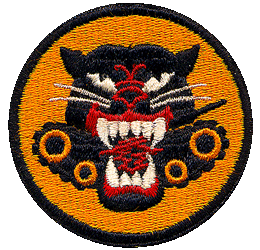
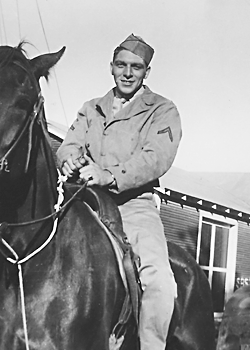
Service Time: Harry entered the service and after his basic training was assigned to the Pioneer (later Reconnaissance) Company of the 630th Tank Destroyer Battalion. The unit trained at a number of military facilities after being activated at Fort Jackson, South Carolina, on December 15, 1941. The 630th moved to Fort Hood, Texas, for their primary training with the tank destroyers and received additional training at Camp Bowie, Texas, Camp Blanding, Florida, and Camp Rucker, Alabama. They also participated in the Tennessee Maneuvers in March through June of 1943.
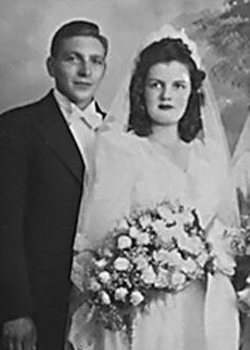
Harry was able to take leave from June 12th to the 24th and although the couple had planned to wait, he called home and said, “Get ready honey, I’ve got some leave, let’s get married”. On June 14, 1942, Harry married the former Helen Mary Bosland who was born in Paterson, New Jersey and was the daughter of Henry Bosland and Pauline Coleman. As you can see from the wedding photo below, he is not in uniform. Although it was very much against the rules, he didn’t want his wife to always be reminded of the war, by their wedding photo, if he didn’t come back.
After returning to the unit it was only a few months until he transferred to Headquarters Company on September 14th and functioned as a cook for the battalion.
 The 630th shipped out on June 3, 1944, from the New York port, aboard the ship New Amsterdam. They arrived in England on June 12th and after a month of additional training and final preparations, they boarded LST transports and landed at Omaha Beach, Normandy, France, on July 24th.
The 630th was equipped with 3″ towed anti-tank guns and entered the line near Colombieres. They advanced across France with the 28th Infantry Division to Luxembourg and supported operations against the Siegfried Line in September & October. Operating in the Hürtgen Forest in November, they shifted to the Ardennes sector in late November and were still located there at the start of German offensive in December.
Harry and a number of other soldiers from the unit were given a few days leave and traveled either to a rest area or a city under allied control for some much-needed recuperation. The rest of the unit soon entered a period of intense actions against the enemy. As of the 16th, the 630th was still attached to the 28th Inf Div, VIII Corps of the First US Army. Their division sector extended from the vicinity of Sevnig, Germany on the North to the vicinity of Echternach, Luxembourg on the South. The front lines were generally along the Our River on the Luxembourg – Germany border. At 0500 that same morning, the Germans began shelling the main highway and a number of towns in the area. Guns from Company B moved into direct firing positions along with guns from Company A and C also moving to engage the enemy.
During the night of the 17th-18th, the unit moved north to strengthen defenses of Wiltz, Luxembourg, as enemy forces moved in that direction. The Commanding officer of the 630th was called to Wiltz, to coordinate anti-tank defenses there. The unit CP (command post) had been located at Knaposcheid but was forced to move toward Hamiville due to enemy encirclement. The vehicles were abandoned and the CP Group moved on foot to Longvilly. Heavy fighting continued into the 19th with enemy tanks and infantry attacking Wiltz from Nocher. It was during this time period that Harry and the other men started back from leave to where the CP had been when they left, Knaposcheid. When they arrived, the camp was no longer there and they were told to head toward Wiltz and attempt to reconnect. He recalled the small group, including himself was about 5 or 6 men and it was now either late on December 18th or early on the morning of the 19th. Making their way through wooded areas, they were captured by German troops near Wiltz on the 19th. It was not until December 24th that word was sent to notifiy the family that he was MIA (Missing in Action) but they didn’t receive a telegram until late January or early February.
From there the men were forced to march into Germany from the 19th to January 1, 1945. While on the march, one of his friends was shot in the head by a German officer with his sidearm. At one point, Harry became overcome with exhaustion and started to fall forward. Another soldier grabbed him and helped him to keep moving telling him “Harry! wake up! you have to stay awake or they’ll shoot you.” He credited that soldier for saving his life. The men were marched to Muhlburg, Germany, which was the location of Stalag IV B, Muhlburg Sachsen 51-13 POW (Prisoner of War) camp. The first notification of his capture came on December 24th.
 The 630th continued the fight, shifting south to the Colmar area in January, 1945, where the 28th Infantry Division operated under French control. They returned north in mid-February only to redeploy south to the Saar region in mid-March, after which the battalion converted to the M36 Tank Destroyer. The unit participated in the elimination of the Ruhr Pocket in April and took up occupation duties at Zweibrücken on April 28th. The 630th finished the war with credit for five campaigns, including Normandy, Northern France, Rhineland, the Ardennes-Alsace and Central Europe.
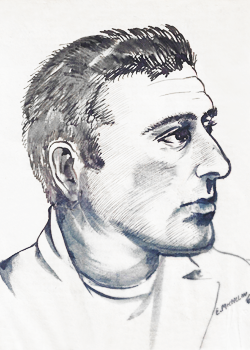
The drawing of Harry on left was done by one of the other prisoners at the Stalag IV B Camp.
Harry endured horrendous conditions during captivity and remained in the POW camp until April 23, when it was liberated by Soviet troops, but American and British POWs were held there for over a month. Some did escape and tried to walk toward American lines on the Elbe River to be airlifted or transported home. Stalag IV B was one of the biggest POW camps in Germany and when it was liberated, it held about 30,000 prisoners. He finally left the camp and was shipped home but he stayed on a military base with other POWs so they could regain their strength and recover. It wasn’t until April 26th that the family found out by telegram that he was a POW. The last telegram was received on August 1st, telling them that he would be arriving at Fort Dix, NJ on Tuesday and that he would see them soon.
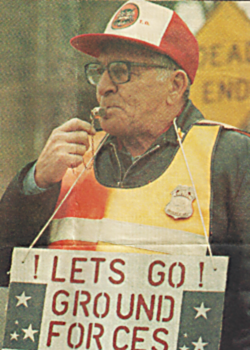
Harry was finally reunited with his family, which now included a daughter, Beverly, born in 1944. The family made their home in Hawthorne, NJ and then West Paterson, now known as Woodland Park, New Jersey, and welcome a second daughter, Paula in 1953. Harry returned to his former occupation of masonry, working as a bricklayer. In his spare time, he enjoyed golf and was a member of the American Legion, Veterans of the Battle of the Bulge and American Ex-POWs. He passed away on August 17, 1998, and was buried in the Garden of Memories in Oradell, NJ.
I want to thank Harry’s granddaughter, Kim, for providing the information and photos used in this tribute.